 Updated for the current LSAT
You keep missing the same questions Find the page that fixes it
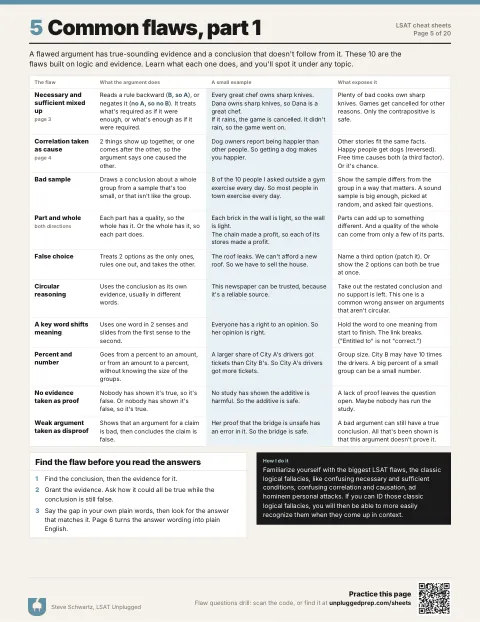
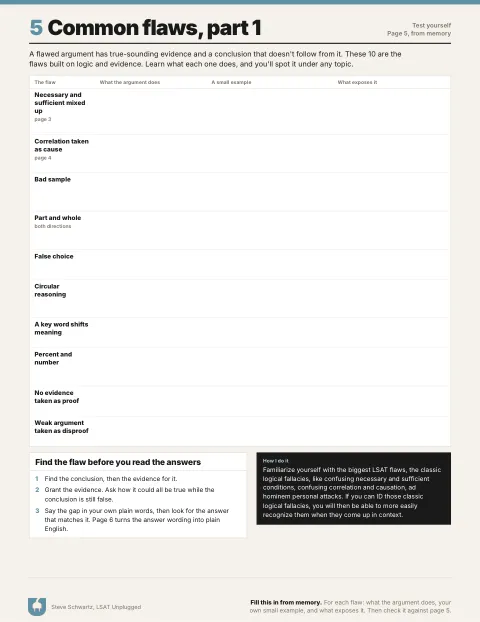
The free LSAT cheat sheet gives each topic its own page, so you can check a rule in seconds and get back to your questions. Then you fill in a blank copy from memory and see what stuck.
Read a page now: the if‑then logic cram sheet
This is a full page from the cheat sheet, and you don't need to sign up to read it. It's the page I'd learn first. Most of the formal logic on the test comes down to 2 skills. Turn a sentence into an arrow, and know how much "some," "most," and "all" really promise. Arrows read left to right: the left side is enough, the right side is required.
The one rule A → B
| If you have A | you get B | valid |
| If you don't have B | you don't have A (not B → not A) | valid |
| You have B | so you have A (reversed) | not valid |
| You don't have A | so you don't have B (negated) | not valid |
Turning words into arrows
| if, when, whenever, all, any, every, each, anyone who | What follows is the "if" part. |
| then, only, only if, must, requires, needs, depends on, guarantees, ensures | What follows is the "then" part. |
| A if B | B → A |
| A only if B | A → B |
| The only A are B | A → B. "The only" works like "all." |
| A unless B (also without, until, except) | Read it as "if not." not B → A |
| No A are B (also none, never) | A → not B, and B → not A |
| A if and only if B | A ↔ B. You get both or neither. |
| Either A or B | not A → B. At least 1. Both is allowed unless it says "but not both." |
One sentence, start to finish
"No refund without a receipt." Read "without" as "if not": no receipt → no refund. Flip it: refund → receipt. "I have a receipt, so I'll get a refund" reads the rule backward.
Chains, and, or
A → B and B → C link up when the middle term matches. You get A → C and not C → not A. You never get C → A.
When you flip a rule, "and" turns into "or," and "or" turns into "and."
A → B and C flips to not B or not C → not A
A or B → C flips to not C → not A and not B
How much each word promises
| None0 | no, never, not any |
| Someat least 1 | sometimes, can, may, could |
| Manymore than 2 | several, numerous |
| Mostmore than half | usually, generally, typically, tends to, probably, likely, the majority |
| All100% | every, each, any, always, without exception |
What you can combine
| All A are B + all B are C | All A are C |
| Most A are B + all B are C | Most A are C |
| Some A are B + all B are C | Some A are C |
| Most A are B + most A are C | Some B are C |
| All A are B + some A are C | Some B are C |
| Some A are B | Some B are A |
| Most A are B | Some B are A |
Dead ends (nothing follows). Some + some. Most A are B + most B are C. All A are B + some B are C. And "most A are B" never tells you most B are A.
The pattern: the shared group has to sit on the left of an "all," or 2 "mosts" have to be about the same group.
Negating the opposite, not the extreme
| all | not all (at least 1 isn't) |
| some | none |
| most | half or fewer |
| always / never | not always / at least once |
| must | doesn't have to |
| A → B | A can happen without B |
Where people slip
Send me the full cheat sheet
What's inside
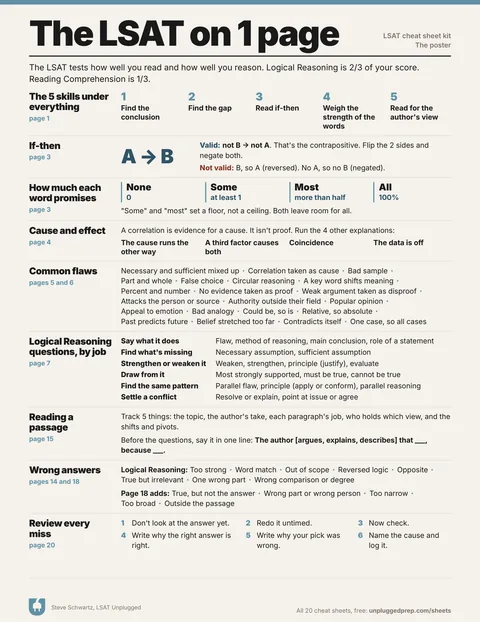
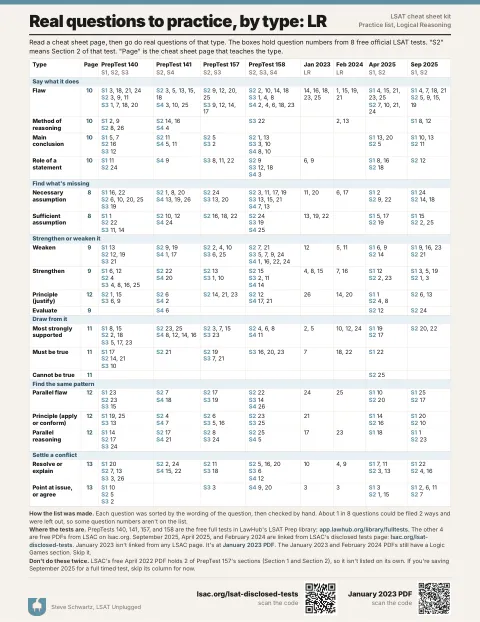
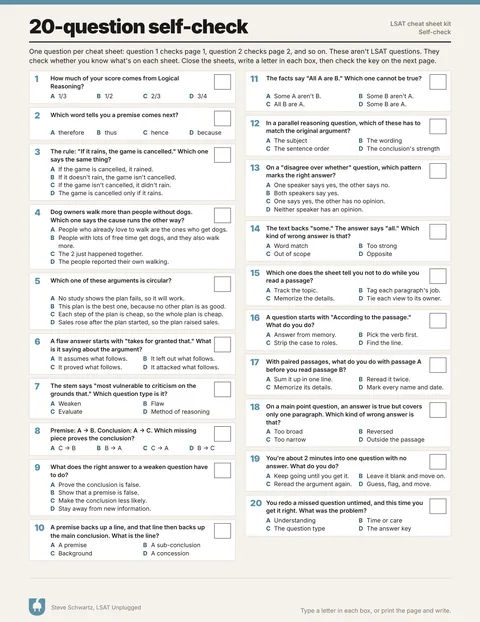
A cheat sheet for each topic, from the parts of an argument and if-then logic to common flaws, the Logical Reasoning and Reading Comprehension question types, wrong answers, and pacing. Each one has a QR code that takes you to practice on that topic.
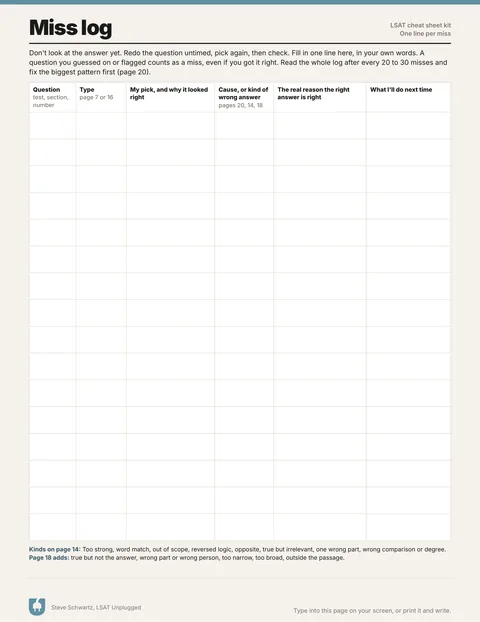
Blank copies to fill in from memory. If you can't fill one in, that's the page to read again tomorrow.
A finder for what keeps going wrong. Look up the mistake and it sends you to the page that covers it.

I've been coaching the LSAT since 2005.
Steve Schwartz, founder
Reuters · Law.com · The Wall Street Journal · The New York Times · The Atlantic · U.S. News · ABA Journal · Above the Law
Quick answer
Is there an LSAT cheat sheet for the question types?
Yes. The free cheat sheet has its own pages for the Logical Reasoning and Reading Comprehension question types, next to the pages on if-then logic, common flaws, wrong answers, and pacing. Each page comes with a blank copy, so you can fill it in from memory and see which question types you still mix up.
Get the free LSAT cheat sheet
Tell me where to send it and it's yours.
I hate spam too. Your email stays with me, and you can unsubscribe anytime.
